
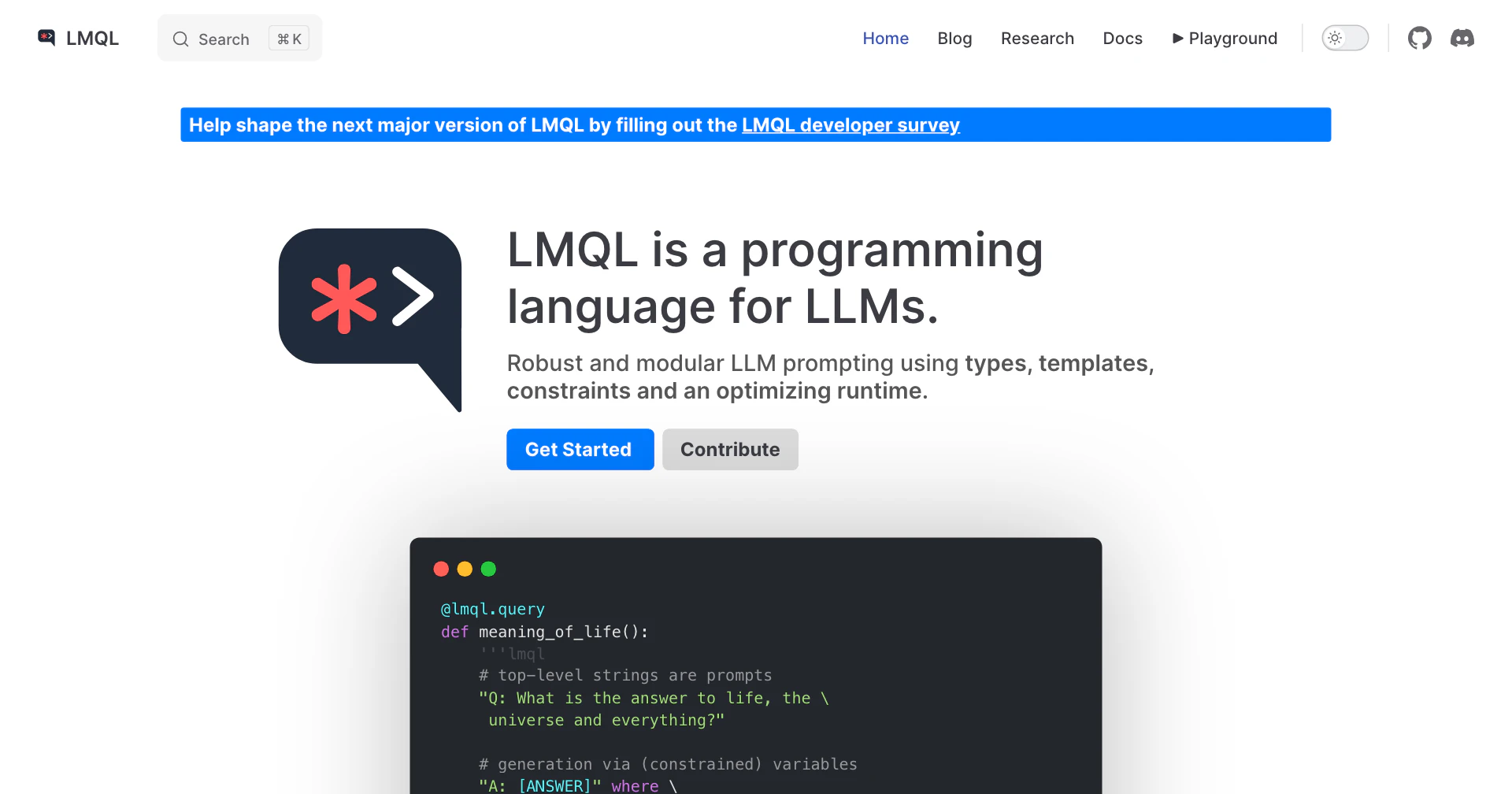
Lmql Overview, Features & Pricing (2026)
LMQL is a specialized programming language created for the effective prompting of large language models (LLMs). It offers robust and modular prompting capabilities utilizing types, templates, constraints, and an optimizing runtime, allowing developers to build complex query programs with ease.
This tool is especially useful for developers and researchers working with LLMs who are looking for an efficient way to manage prompts and queries. With features like typing for guaranteed output formats and the ability to make code portable across various backends, LMQL enhances the experience of working with language models and facilitates better integration into Python applications.
- Modularized Prompting — Organize and reuse prompt components using nested queries.
- Type Enforcement — Use typed variables to guarantee specific output formats.
- Portable Code — Switch between multiple backends with just a single line of code.
- Expressive Control Flow — Implement prompting via Python-style control structures.
Current pricing details for LMQL are not available. For the most updated information, please refer to the official pricing page on their website.
Why to choose Lmql?
Choosing LMQL allows developers to leverage a powerful and flexible language tailored specifically for LLM interactions. Its ability to modularize prompts and enforce types ensures that users can create more reliable and dynamic outputs, enhancing the overall functionality of their applications.
Additionally, LMQL's cross-backend compatibility and integration with Python make it a versatile choice for anyone looking to optimize their work with language models.